
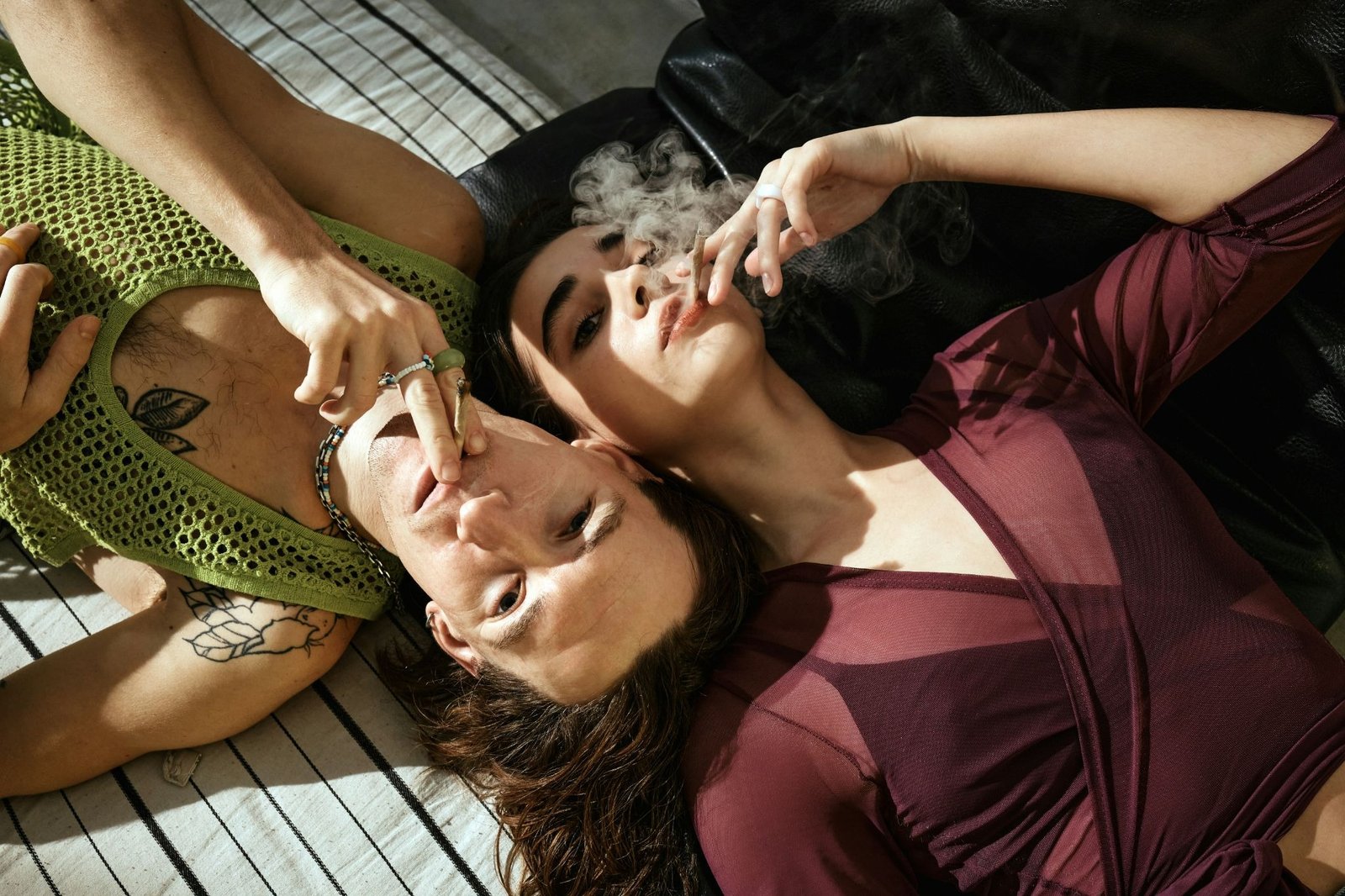

There is a long and well-documented relationship between cannabis and creative work. Musicians, writers, visual artists, and filmmakers have pointed to it as a tool for decades, and the names attached to that history are not fringe figures. The conversation, however, has rarely moved beyond the anecdotal. People either believe cannabis makes them more creative or they do not, and both camps tend to dig in without much interest in the underlying mechanics.
The mechanics are worth understanding because they change everything about how you approach this. Using cannabis for creativity is not about getting as high as possible and waiting for inspiration to arrive. It is about understanding which specific compounds in the plant interact with the neurological systems that govern creative thought, and then choosing strains that target those systems deliberately. When you get that right, the experience is genuinely different from casual use. When you get it wrong, you end up staring at a blank page feeling pleasantly distracted and wondering why nothing came.
What Happens in the Brain During Creative Thinking
Creativity is not a single cognitive process. It involves a dynamic interaction between two large-scale brain networks that typically operate in opposition to each other. The default mode network, which is active during daydreaming, imagination, and self-referential thought, generates novel associations and ideas. The executive control network handles focus, evaluation, and the filtering of those ideas into something coherent and usable. In most people, these networks suppress each other, which is part of why genuine creative flow is rare and hard to sustain.
Research using neuroimaging has shown that highly creative individuals have unusually strong functional connectivity between these two networks, meaning they can run both simultaneously rather than toggling between them. The default mode generates freely while the executive function evaluates without shutting the generation down. What some psychoactive compounds appear to do, cannabis among them at low to moderate doses, is temporarily loosen the dominance of executive suppression, allowing the default mode network more freedom to make connections that sober, analytical thinking tends to prune before they can surface.
This is why the dose relationship matters so much for creative use. Too little THC and you may not notice any shift in how your mind is moving. Too much and the executive function is so suppressed that the ideas you generate feel profound in the moment but dissolve into incoherence when you look at them the next morning. The creative window is a specific band, and terpenes are a significant part of what determines how wide that band is and how comfortably you can stay in it.
Why Terpenes Are the Real Story for Creative Cannabis Use
THC opens the door. Terpenes determine what kind of room you walk into.
A high-THC strain dominated by myrcene is going to sedate the body and quiet the mind in ways that are counterproductive for active creative work, regardless of how much THC it contains. A strain with comparable THC but a terpene profile rich in terpinolene, limonene, and pinene is going to produce a fundamentally different cognitive state, one that is alert, associative, and generative rather than heavy and passive.
Terpinolene is arguably the most important terpene for creative work and the one that receives the least mainstream attention. It carries a complex, layered aroma that combines herbal, floral, citrus, and pine notes, and strains dominant in terpinolene are consistently described as producing a clear-headed, uplifting, mildly psychedelic quality that is distinctly different from anything else in the cannabis catalog. The thinking feels faster and more lateral. Connections between unrelated ideas surface more readily. There is a quality of mental brightness that experienced creatives describe as uniquely suited to generative work. Durban Poison is the most widely available terpinolene-dominant strain and has earned a devoted following specifically among artists and writers for exactly this reason.
Limonene contributes the mood elevation and anxiety reduction that allows creative vulnerability. A significant reason many people struggle to access creative flow is not lack of ideas but psychological resistance, the inner critic that shoots down half-formed concepts before they have a chance to develop, the self-consciousness that makes putting something imperfect onto paper or canvas feel unbearable. Limonene’s anxiolytic properties directly address that barrier. Strains rich in limonene tend to produce an openness and ease that makes the generative process feel less threatening and more playful.
Pinene adds a dimension that is underappreciated in the creativity conversation: mental clarity and memory retention. Cannabis, particularly at higher doses, can impair working memory in ways that frustrate creative work. You have an idea, you follow it somewhere interesting, and by the time you come back to the original thought it has evaporated. Pinene inhibits the enzyme that breaks down acetylcholine, a neurotransmitter central to memory consolidation, which means pinene-rich strains can help you hold the thread of an idea while you follow its implications. For writers especially, this distinction is not minor.
The Strains That Consistently Deliver for Creative Work
Durban Poison deserves its reputation as the creative strain above all others. A pure sativa landrace from South Africa with one of the highest terpinolene concentrations found in commercially available cannabis, it produces a focused, energetic, mentally expansive effect that feels almost custom-built for sustained creative output. The effect is clean rather than hazy, with a clarity that makes it functional for actual work rather than just pleasant rumination. If you have tried high-THC strains for creativity and found them too foggy or too paranoia-prone, Durban Poison is the strain most likely to change your mind.
Jack Herer is the classic for a reason. Named after the cannabis activist and author, it carries a pine and citrus profile driven by terpinolene, pinene, and myrcene in a balance that delivers clear-headed energy without the raciness that can accompany pure sativa genetics. It is forgiving enough for users who are not certain of their exact tolerance sweet spot, which makes it a reliable starting point for anyone approaching cannabis-assisted creative work for the first time.
Super Lemon Haze brings a pronounced limonene dominance that makes it particularly well suited for creative work with a strong psychological barrier component. The bright citrus aroma is vivid and immediately uplifting, and the effect leans into social ease and creative confidence rather than introverted contemplation. Musicians, performers, and anyone whose creative process involves collaboration or presentation often cite Super Lemon Haze as a more useful companion than the more introspective sativa-dominant options.
Strawberry Cough carries a limonene and myrcene profile that produces a gentle, warm creative energy suited to visual artists and anyone whose process benefits from a slowed-down, sensory-rich experience. The strawberry flavor is genuine and the effect is notably smooth, making it one of the more approachable options for daytime creative use at moderate doses.
Ghost Train Haze is at the more intense end of the spectrum and is not the right starting point for someone new to cannabis or sensitive to THC. For experienced users looking for the deepest access to lateral, associative thinking, its terpinolene and ocimene-rich profile produces an effect that many describe as the most psychedelically creative available in a commercially grown strain. Approach with respect and a lower dose than you think you need.
For reliable access to consistent, quality versions of these strains rather than whatever happens to be available locally, platforms like Got Flower make it practical to shop by effect profile and terpene characteristics rather than relying on strain names alone.
How to Structure a Creative Session with Cannabis
The preparation you do before consuming matters as much as the strain you choose. Cannabis for creativity works best when the work is already in front of you rather than using it to generate motivation from scratch. Open the document, set up the canvas, put the instrument in your hands, and then consume. You are lowering the activation energy for a process that already has direction, not trying to summon direction from nothing.
Dose low and give it time. For creative work specifically, the goal is a subtle shift in how your mind is moving, not a pronounced high. One to two inhalations from a terpinolene-rich strain, or a 5mg edible for those who prefer a more controlled onset, is a reasonable starting point. The most common mistake is consuming too much in the early minutes because nothing feels different yet, then spending the next two hours too impaired to do focused work. The creative window is subtle when you hit it correctly.
Time your session to match your natural creative rhythms. If you are a morning person who does their best work in the first few hours of the day, use cannabis then. If you are someone who hits a creative stride in the late afternoon or evening, align your session to that window. Cannabis does not override your natural rhythm, it amplifies whatever state you are already moving into.
Minimize distractions more aggressively than you normally would. The associative thinking that cannabis facilitates is easily hijacked by external stimuli. A phone notification mid-session can pull you out of a generative flow state that took 45 minutes to develop and is difficult to return to. Protect the time with the same seriousness you would bring to any focused deep work practice.
Frequently Asked Questions
1. Does cannabis actually make you more creative or does it just make you feel more creative? Both things are partially true, and the distinction is meaningful. Research suggests that cannabis does increase divergent thinking, the ability to generate multiple novel ideas from a single prompt, particularly at low to moderate doses. However, it does not reliably improve convergent thinking, the ability to evaluate and refine those ideas into a finished product. Many users report generating more ideas under cannabis but needing to evaluate and edit them sober. Using cannabis strategically for the generative phase while doing critical editing and refinement without it is a practical approach that respects both capabilities.
2. Why do some people feel creatively blocked rather than inspired when they use cannabis? Strain choice and dose are usually the culprits. High-myrcene, indica-dominant strains sedate rather than stimulate the associative thinking associated with creativity. High doses of any strain tend to suppress executive function to the point where ideas cannot be organized or executed. Anxiety-prone individuals may also find that even moderate THC triggers enough self-consciousness to block rather than open the creative process. Switching to a low-dose terpinolene or limonene-dominant strain often resolves what feels like a personal incompatibility with cannabis-assisted creativity.
3. Are there specific creative disciplines that benefit more than others from cannabis use? User reports and the limited research available suggest cannabis is most consistently beneficial for disciplines that rely heavily on divergent thinking, lateral association, and sensory engagement. Music composition, visual art, writing fiction, and brainstorming across fields are frequently cited as disciplines where the benefits are most reliable. Highly technical creative work that demands precision and systematic problem-solving tends to be less compatible with THC, where CBD or very low-dose THC is more appropriate if cannabis is being used at all.
4. Can you build a tolerance to the creativity-enhancing effects specifically? Yes. The same CB1 receptor downregulation that reduces the euphoric effect with daily use also dulls the more subtle cognitive effects associated with creative enhancement. This is one of the strongest arguments for reserving cannabis-assisted creative sessions for specific projects or sessions rather than using it as a daily creative crutch. Keeping use intentional and infrequent preserves the sensitivity that makes the experience useful.
5. Is there a risk of becoming dependent on cannabis to access creative flow? This is a legitimate concern that deserves honest acknowledgment. While physical dependence on cannabis is less pronounced than with many other substances, psychological dependence on any external tool for creative access can quietly undermine your confidence in your own unassisted creative capacity. The most sustainable approach is to use cannabis as an occasional creative accelerant while continuing to develop your baseline creative practice without it. That way the tool enhances what already exists rather than becoming a prerequisite for accessing it.