
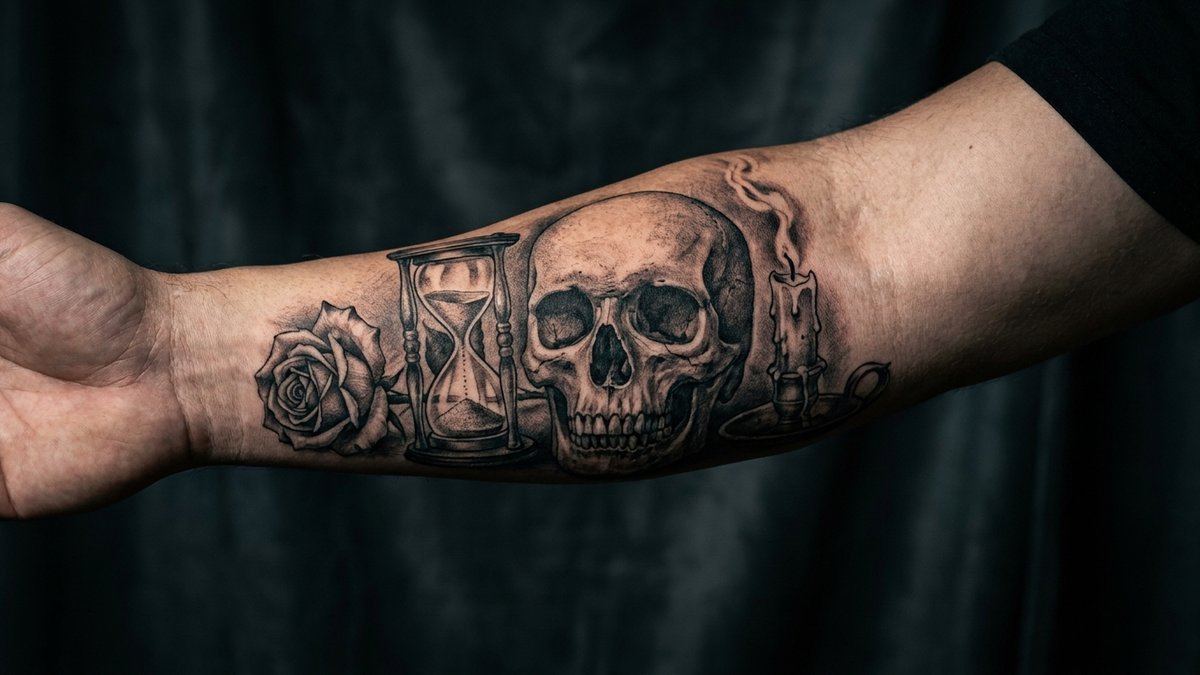

The phrase shows up tattooed on forearms, ribcages, and the inside of wrists more often than most tattoo artists can keep up with. “Memento mori.” Two Latin words. The literal translation — “remember you must die” — sounds grim until you understand what it was originally for.
Roman generals had a slave whisper it during their victory parades. Stoic philosophers wrote it on their bedroom walls. The skull tattoo you saw at the gym last week is part of a 2,000-year-old practice that has very little to do with death and almost everything to do with how to live. Here’s the memento mori tattoo meaning the studios that respect this history actually carry.

What “Memento Mori” Actually Means (Beyond the Skull)
Most modern tattoo artists will tell you “memento mori” means “remember you will die.” That’s the translation. The function is something else entirely.
The phrase comes from ancient Rome — specifically from the triumph, the elaborate parade given to a victorious general. As he rode through the city in his chariot, history records that a slave stood behind him, holding a laurel crown above his head and whispering memento mori into his ear.
The crowd worshipped him. The slave reminded him he was mortal. The whole point of the ritual was to keep success from corroding the man underneath it.
Stoic philosophy picked the phrase up a few hundred years later. Marcus Aurelius wrote variations of it throughout his private journals (now published as Meditations). The reasoning was straightforward — if you genuinely accept that your time is finite, you stop wasting it on resentment, vanity, and trivial fights.
The memento mori meaning isn’t about morbid fixation. It’s about clarity.
When that phrase ends up tattooed on someone in 2026, the function is usually the same. A daily, glanceable reminder. Not a death wish. The opposite of one.
The Four Symbols That Show Up in 90% of Memento Mori Tattoos
Tattoo studios that specialize in memento mori work draw from a small visual vocabulary — four core symbols that have been used in death-related art since at least the 1500s. Each one carries a specific meaning, and most memento mori tattoos combine two or three.
The Skull
The most common element by far. The skull strips a human face down to what survives the body — the part that lasts. In vanitas paintings, it sat next to fresh fruit and burning candles, the durable thing surrounded by perishable ones.
As a tattoo, it works the same way. A clean realistic skull. A stylized line-work skull. A skull with flowers growing through the eye sockets. The variations multiply, but the meaning anchors the same place: this is what’s permanent about you.
The Hourglass
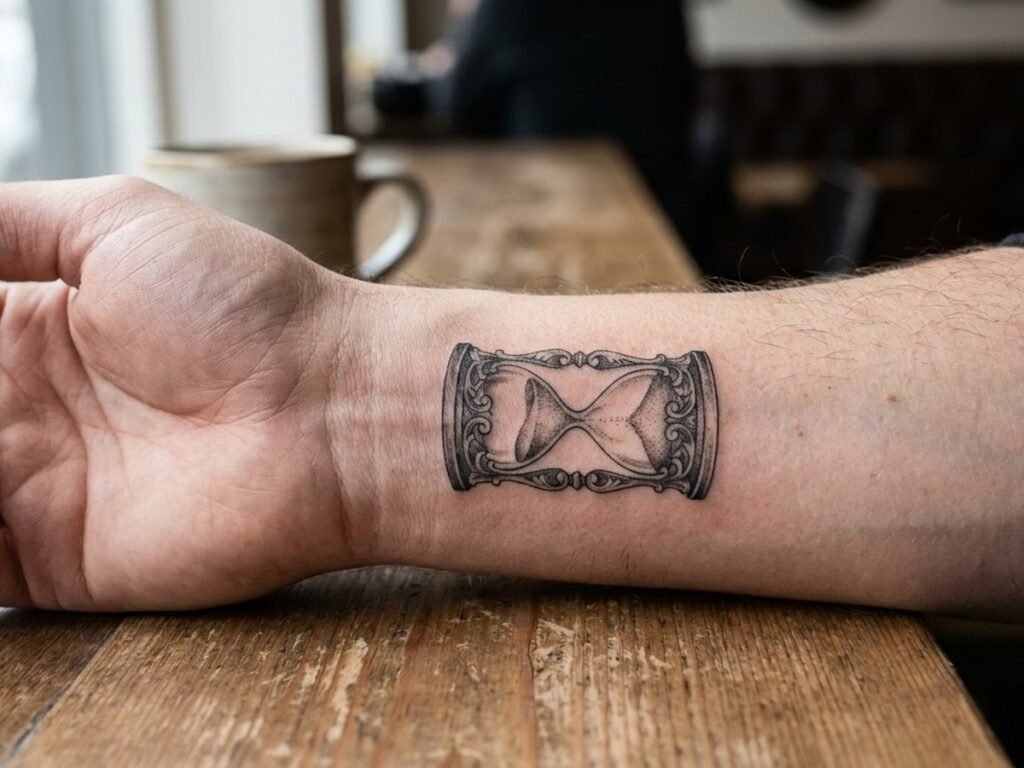
Sand falling visibly from one chamber to the other. It’s the literal version of “your time is finite.” Tattoo artists often render the hourglass partially full, partially empty — the implication being that you don’t know how much sand is left, only that it’s moving. Some clients ask for the hourglass tipped sideways, sand suspended mid-fall, to represent a specific moment they’re trying to honor.
The Wilted Flower
Borrowed from Dutch vanitas painting, the wilted flower sits next to skulls in 16th-century still lifes as the soft counterpoint to bone. Beauty existed; beauty faded. In modern memento mori tattoos, it usually appears as a single rose past its peak — petals dropping, stem bent. A reminder that the things you find beautiful are exactly the things most subject to time.
The Extinguished Candle
The candle in a memento mori design is almost never lit. It’s been blown out, sometimes with smoke still curling from the wick. The visual carries the same logic as the hourglass — what burned has burned. The candle works particularly well on the inside of the forearm, where the wrist puts it directly in the wearer’s eyeline whenever they check the time.

Why People Get This Tattooed (Not Just the Aesthetic)
The aesthetic alone is enough for some clients — black-and-grey skulls and Renaissance-style symbolism photograph beautifully and age well on skin. But the deeper reason memento mori tattoos keep showing up on people who could have picked anything is more practical.
A tattoo is the most reliable reminder system humans have invented. It’s not on a phone you can ignore, not in a journal you can stop opening. It’s on your body, visible whenever you push up a sleeve or change a shirt.
Marcus Aurelius wrote, “You could leave life right now. Let that determine what you do and say and think.” A tattoo turns that idea into something you re-read involuntarily, twenty times a day, for the rest of your life.
People in recovery — from addiction, from grief, from divorce — often get memento mori work for exactly this reason. The reminder is the point. So is the resistance to letting it become invisible the way ink can over time. The skull stays on the forearm because the wearer needs it to.
There’s also the long association with sterling silver skull rings carved with memento mori detail — the same iconography appears in jewelry traditions that go back to mourning rings of the 1600s. Tattoos and jewelry both belong to the same lineage: portable, visible, deliberate reminders of mortality worn by people who decided to take that reminder seriously.
Tattoo Placement That Matters (And Why Forearm Wins)
Memento mori tattoos work best when the wearer can see them. That’s not how all tattoos function — back pieces and ribcage work are often designed to be seen by other people. Memento mori is designed for the person wearing it.
The inside of the forearm is the most common placement for exactly this reason. It’s the surface you see whenever you check your phone, drive, type, or pour coffee. A skull and hourglass placed there gets re-read hundreds of times a week without conscious effort. The reminder integrates into daily life instead of waiting for moments of reflection.
The inner wrist works for the same reason but with a tighter footprint — usually limited to a single symbol or short Latin phrase. Some wearers prefer the upper chest near the heart for a more private placement; the symbol is rarely visible to others but always available to the wearer in mirrors and when changing.
Placement on the back, calf, or thigh is more decorative than functional. The reminder is still there in principle, but it’s not in the daily eyeline. For most clients commissioning memento mori work, that distinction shapes the choice.
When Permanent Ink Isn’t the Path
Not everyone wanting a memento mori reminder is ready for a tattoo. Skin reacts. Careers complicate it. Some people simply prefer reminders they can take off — not because the philosophy is less important, but because the form matters less than the function.
The same symbols appear in jewelry, and they’ve been there longer than they’ve been on skin. Sixteenth-century mourning rings carved skulls into the bezels of gold bands. Eighteenth-century pocket watches concealed skull motifs under hinged covers.
The Mexican Day of the Dead tradition produced sugar skulls and silver ofrenda pieces centuries before tattoos became the modern default. The full history of memento mori jewelry traces the same four symbols — skull, hourglass, flower, candle — across rings, pendants, brooches, and rosaries. Bikerringshop’s guide to memento mori jewelry covers the design tradition in depth, including the vanitas paintings the iconography came from.
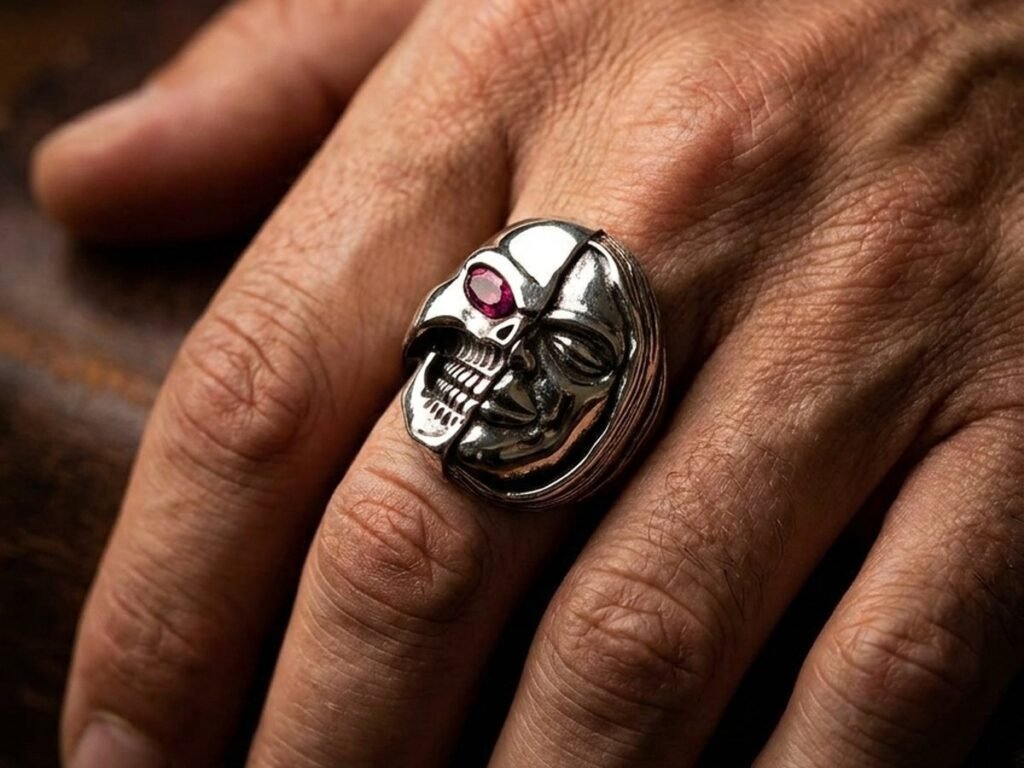
Whether the reminder ends up on skin or on a chain, the underlying choice is the same — a deliberate, visible artifact whose only job is to keep mortality in the foreground long enough to matter.
Frequently Asked Questions
Q: What does memento mori mean in tattoos?
“Memento mori” translates to “remember you must die” in Latin. In tattoo form, it usually combines the phrase with symbols like skulls, hourglasses, or wilted flowers. The function isn’t morbid — it’s a Stoic-philosophy reminder that finite time should sharpen daily decisions. Most wearers describe it as a clarity tool, not a death fixation.
Q: Is a memento mori tattoo disrespectful or religious?
Neither, in most cases. The phrase predates Christianity (Roman triumph rituals used it), though Christian monasteries adopted it heavily through the medieval period. Modern memento mori tattoos draw from Stoic philosophy more than any specific religion. The iconography is open enough that wearers from any spiritual background — or none — use it without contradiction.
Q: What’s the best placement for a memento mori tattoo?
The inside of the forearm or wrist is most common, specifically because the wearer sees it constantly. The whole point of the symbol is daily reminder, so placement should match that function. Back pieces and ribcage work are more decorative but lose the “reread it twenty times a day” benefit that makes the reminder effective.
Q: Do I need to know Latin to get a memento mori tattoo?
No, but most artists will spell-check the phrase carefully. “Memento mori” (not “momentum mori” — a common misspelling) is the standard form. Some clients add the answering phrase “memento vivere” (remember to live) to balance the message. Either is grammatically correct Latin.
The skull on someone’s forearm isn’t decoration when it’s done right. It’s a thousand-year-old idea, compressed into a single image, designed to be read so often that it shapes the day instead of just marking it. Whether it goes under a needle or onto a chain around the neck, the question it raises is the same one Marcus Aurelius wrote down at three in the morning two thousand years ago. The phrase still works.
About the author: The author has worked in the men’s jewelry and accessories industry for over 15 years, with a focus on symbolic and gothic design traditions. He curates handcrafted sterling silver pieces and exotic leather goods at Bikerringshop.