
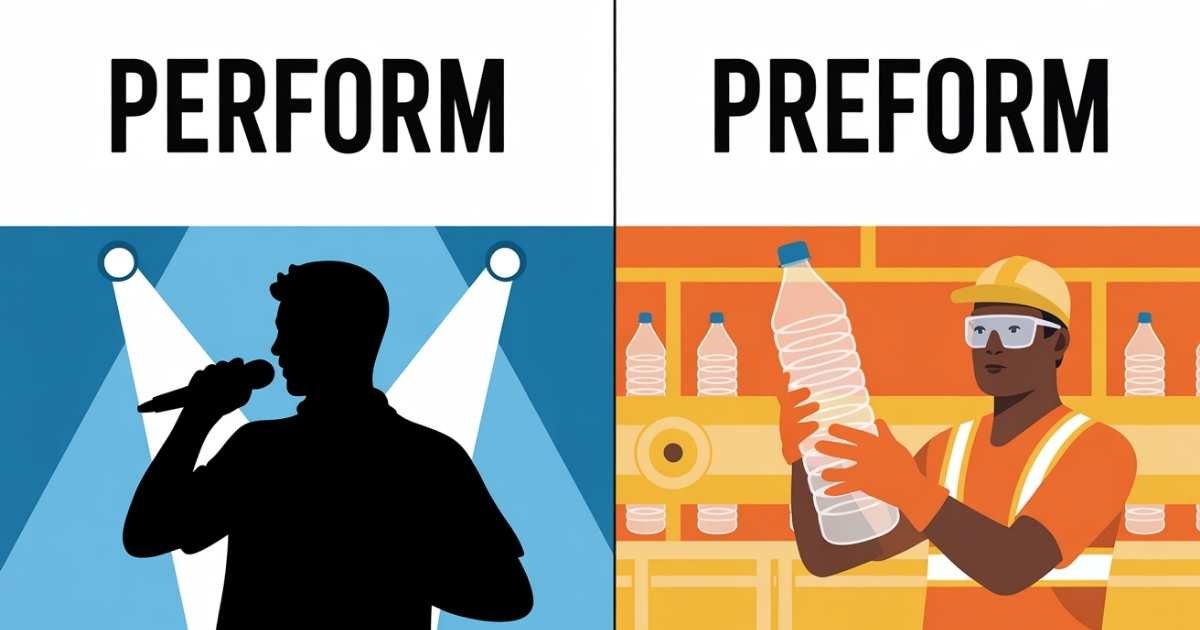

Ever typed “preform” when you meant “perform”? You’re not alone. These two words look similar but mean totally different things. One involves doing actions while the other shapes materials beforehand. This mix-up happens constantly in writing and speech.
In this article, you’ll learn the difference between perform and preform, real-world examples, common mistakes to avoid, and memory tricks to never confuse them again.
Perform vs Preform: An Overview
Let’s cut straight to it. Perform means to carry out an action or complete a task. Preform means to shape something in advance before final production.
The perform meaning is super common. You hear it everywhere. People perform tasks at work. Musicians perform concerts. Students perform well on tests. It’s an everyday action-based verb you probably use without thinking.
The preform meaning is totally different. It’s technical and specialized. Manufacturers preform plastic bottles. Engineers preform metal parts. It’s all about shaping materials in production before they reach their final form.
Here’s the kicker: perform appears millions of times more often. Most people never use “preform” unless they work in manufacturing or engineering. That’s why the perform vs preform confusion exists.
| Word | Common Usage | Where You’ll See It |
| Perform | Extremely common | Everywhere daily |
| Preform | Rare and technical | Factories and labs only |
What Does “Perform” Mean?
Definition and Part of Speech
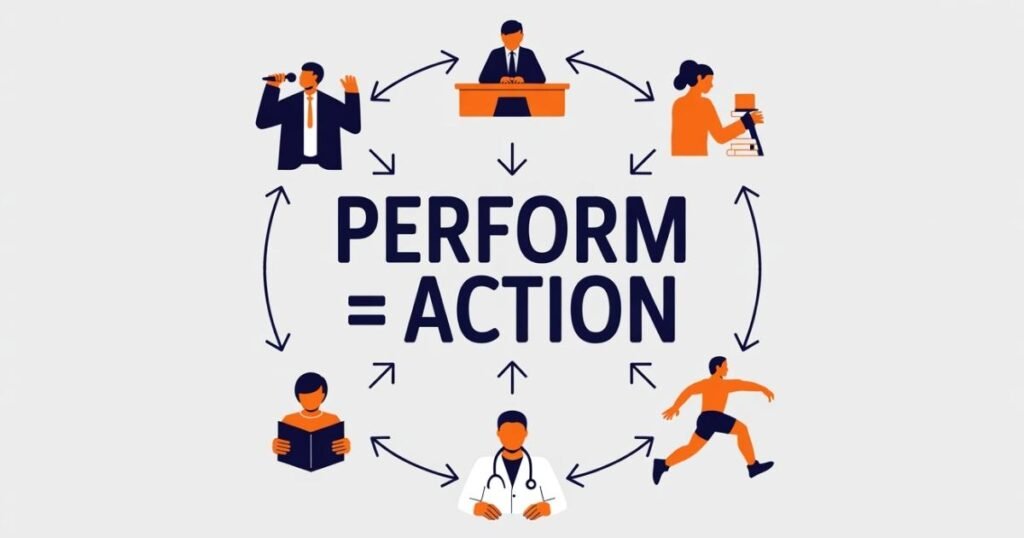
The perform definition is straightforward. It means to do something or carry out an action. As a verb, it describes activity and execution.
You can use different forms: perform, performs, performing, performed. All describe completing actions or tasks. The word comes from Latin “performare” which means “to carry out completely.”
Usage in Real-Life Contexts
Entertainment and Arts
Performing arts is probably the most recognizable context. Actors perform plays on Broadway. Singers perform concerts at stadiums. Dancers perform routines at competitions.
Think about Taylor Swift performing at a sold-out arena. That’s stage performance in action. The audience watches someone execute their craft live.
Professional and Workplace Contexts
Workplace task execution uses “perform” constantly. Employees perform duties outlined in job descriptions. Teams perform well when they meet quarterly goals.
Your boss might say: “You performed excellently this quarter.” That’s about completing professional communication accuracy and delivering results. Performance reviews measure how well you performed assigned responsibilities.
Academic and Educational Settings
Students perform tasks in every subject. You perform experiments in science class. Athletes track their academic performance through grades and test scores.
Teachers constantly evaluate how students perform. Did you perform well on the math test? Can you perform the required reading by Friday?
Medical and Technical Operations
Doctors perform surgeries in operating rooms. Technicians perform diagnostic tests. Machines perform functions automatically.
These are technical procedure verbs in action. A surgeon might perform five procedures in one day. Each requires precision and skill.
Synonyms and Related Terms
Need alternatives? Try these perform synonyms:
- Execute
- Complete
- Accomplish
- Carry out
- Do
- Conduct
Each works slightly differently but conveys similar meaning.
Common Phrases with “Perform”
You’ll hear these perform examples all the time:
- “Perform a task” (complete assigned work)
- “Perform well” (succeed at something)
- “Perform under pressure” (succeed during stress)
- “Perform duties” (complete job responsibilities)
- “Perform maintenance” (conduct repairs)
- “Perform miracles” (achieve amazing results)
What Does “Preform” Mean?
Definition and Part of Speech
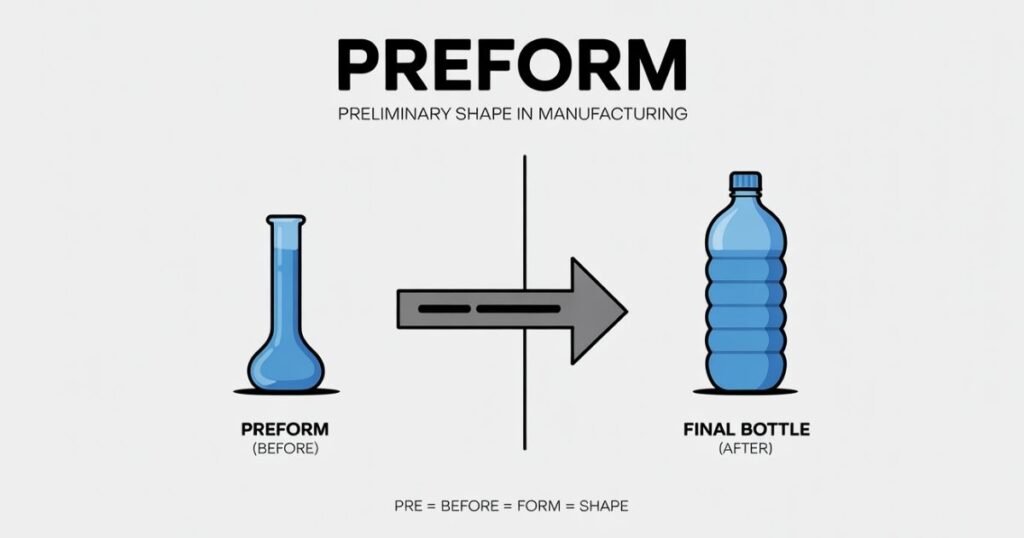
The preform definition gets technical fast. As a verb, it means to shape or form something beforehand. As a noun, it’s the preliminary shape itself.
Break it down: pre means “before” and form means “shape.” Together they describe creating initial forms before final production. This makes sense for manufacturing terminology.
Usage in Specific Contexts
Manufacturing and Engineering
Preform in manufacturing is huge. Plastic bottle preforms are small test-tube shapes. Machines heat and blow them into full bottles. Every plastic bottle you drink from started as a preform.
Preform in engineering includes metal parts shaped before assembly. The manufacturing preform process saves time and materials. Molded components begin as preforms in factories worldwide.
Scientific and Technical Settings
Labs use preforms for experiments. Chemical compounds get preformed before testing. Research facilities create preforms for specialized equipment.
Scientists preform materials to study reactions. It’s all about controlled preparation.
Artisanal and Crafting Applications
Glassblowers create preforms before final shaping. Potters preform clay before detailed work. Metalworkers use preforms as starting points.
These crafting and molding terms help artisans work efficiently. Starting with a preform beats starting from scratch.
Synonyms and Related Terms
Looking for preform synonyms? Try:
- Pre-shape
- Prepare in advance
- Preliminary form
- Initial mold
- Proto-form
Common Phrases with “Preform”
These preform examples show technical usage:
- “Preform a bottle” (create initial bottle shape)
- “Preform the material” (shape material beforehand)
- “Preform stage” (preliminary production phase)
- “Preform mold” (tool for creating preforms)
Also Read: In Person or In-Person: When and Which Should You Use?
Side-by-Side Comparison: Perform vs Preform
Here’s the ultimate perform vs preform grammar breakdown:
| Feature | Perform | Preform |
| Meaning | Do an action | Shape beforehand |
| Usage Frequency | Very common | Extremely rare |
| Main Contexts | Work, arts, daily life | Manufacturing only |
| Part of Speech | Verb | Verb and noun |
| Example | “She performs surgery” | “Factory preforms bottles” |
The difference between perform and preform is massive. One describes general action. The other describes specific industrial shaping.
Common Mistakes and How to Avoid Them
Confusing “Preform” with “Perform”
This spelling confusion perform preform happens constantly. Autocorrect makes it worse. You type “perform” but your phone changes it to “preform.”
Wrong: “The band will preform tonight.” Right: “The band will perform tonight.”
Nobody preforms concerts. They perform them. This misuse of preform sounds ridiculous to anyone who knows the difference.
Overusing “Preform” to Sound Sophisticated
Some writers think “preform” sounds fancier. It doesn’t. It sounds wrong.
Wrong: “I will preform my duties professionally.” Right: “I will perform my duties professionally.”
Unless you’re literally shaping materials, stick with “perform.” This incorrect use of preform makes you look confused, not sophisticated.
The Evolution of “Perform” and “Preform”
The perform pronunciation (per-FORM) hasn’t changed much since the 1300s. It came from Latin through French into English language usage.
“Preform” emerged during the Industrial Revolution. The preform pronunciation (PREE-form) reflects its modern creation. Factories needed words for new processes. Material shaping required specific terminology.
Today, perform appears everywhere in commonly confused words lists. Search trends show people constantly ask: “What is the difference between perform and preform?“
Practical Applications Across Industries
Healthcare uses “perform” exclusively. Doctors perform procedures. Nurses perform assessments. Nobody preforms anything medical.
Entertainment relies entirely on “perform.” Musicians perform shows. Actors perform roles. Zero preforming happens in arts.
Manufacturing uses both words. Workers perform quality checks. Machines preform components. The context determines which word fits.
Education sticks with “perform.” Students perform assignments. Teachers evaluate performance. Schools measure academic achievement through performed tasks.
The Linguistic Landscape: Commonly Confused Word Pairs
The perform vs preform confusion mirrors other tricky pairs in verb usage differences:
- Affect vs effect (verb vs noun)
- Precede vs proceed (come before vs continue)
- Complement vs compliment (complete vs praise)
These similar sounding words in English trip up native speakers constantly. Understanding prefixes helps. “Pre” always means “before.” “Per” means “through” or “completely.”
Learning one confused pair helps you recognize patterns. Your brain starts catching grammar mistakes to avoid automatically.
Everyday Usage Examples
Examples for “Perform”
Check out these real perform usage sentences:
- “Musicians perform at the stadium tonight.”
- “She performs her job duties excellently.”
- “Students must perform well on finals.”
- “The surgeon will perform three operations today.”
- “Athletes perform better after proper training.”
- “Our team performs under pressure consistently.”
- “Can you perform this task by tomorrow?”
- “The computer performs calculations instantly.”
Notice how natural “perform” sounds? That’s because it fits clarity in writing in countless situations.
Examples for “Preform”
Now see technical preform usage:
- “The factory preforms plastic bottles daily.”
- “Engineers preform metal components before assembly.”
- “Glassblowers preform shapes before final work.”
- “The machine preforms thousands of units hourly.”
- “Technicians examine each preform for defects.”
These sound specialized because they are. Only specific industries need this word.
Comparative Examples
Here’s when to use perform vs preform side-by-side:
- Correct: “The actor will perform tonight.” (doing an action)
- Wrong: “The actor will preform tonight.” (makes no sense)
- Correct: “Workers preform bottle shapes.” (shaping materials)
- Wrong: “Workers perform bottle shapes.” (incorrect context)
Performing vs Preforming: Common Errors
Spelling Confusion
The performing vs preforming battle continues online. One letter changes everything. That “e” and “o” swap creates totally different meanings.
People write “preforming” when they mean “performing” constantly. Social media posts, business emails, student essays all contain this error.
Tips to Avoid Mistakes
Follow these language usage guide strategies:
- Ask yourself: “Am I shaping materials?” If no, use perform.
- Check your context. Factory? Maybe preform. Office? Definitely perform.
- Default to “perform” when uncertain.
- Read sentences aloud. Does “preform” sound weird? Change it.
- Remember: preform is rare.
Mnemonics and Memory Tricks
Try these how to remember perform and preform tricks:
“PREform comes BEFOREhand” – The “pre” prefix means before, just like preparing.
“PERform means PERson doing action” – Both start with “per” and involve activity.
“Only factories preform” – If you’re not in manufacturing, you’re performing.
Visual learners can picture a molding process for preform and a stage for perform.
Performed vs Preformed: Past Tense Usage
Performed
The performed meaning describes completed actions. It’s the simple past tense of perform.
Examples:
- “She performed brilliantly yesterday.”
- “The team performed all assigned tasks.”
- “Doctors performed emergency surgery successfully.”
This performed vs preformed difference matters in professional communication accuracy.
Preformed
The preformed meaning describes shapes created earlier. But watch out because “preformed” can be an adjective too.
Examples:
- “The factory preformed these parts last week.”
- “We inspected preformed components.” (adjective use)
Explanation of Misuse
Common mistakes perform preform include these errors:
Wrong: “He preformed the concert beautifully.” Right: “He performed the concert beautifully.”
Wrong: “She preformed her duties professionally.” Right: “She performed her duties professionally.”
These mistakes happen because people don’t understand the shaping vs doing distinction. Concerts and duties involve doing, not preliminary shaping.
Frequently Asked Questions
What is the main difference between perform and preform?
Perform means doing actions or tasks. Preform means shaping materials beforehand in manufacturing processes.
Can I use preform instead of perform in daily conversation?
No, preform is technical manufacturing terminology. Use perform for everyday actions and tasks instead.
How do I remember which word to use correctly?
Remember: PREform comes BEFOREhand (shaping). PERform means doing actions. Factories preform; people perform tasks.
Is preforming a real word or just a misspelling?
Preforming is real but rare. It means shaping materials in manufacturing, not performing actions.
Which word is more common in English language usage?
Perform is extremely common in daily speech. Preform rarely appears outside manufacturing and engineering contexts.
Conclusion
The perform definition centers on doing actions and completing tasks. The preform definition focuses on shaping materials beforehand for manufacturing. Understanding this difference between perform and preform prevents embarrassing mistakes.
Remember that “perform” dominates everyday usage while “preform” stays locked in technical industries. Next time you write, ask yourself if you’re describing action or preliminary shaping. That simple question ensures correct word selection every time. You’ve got this!